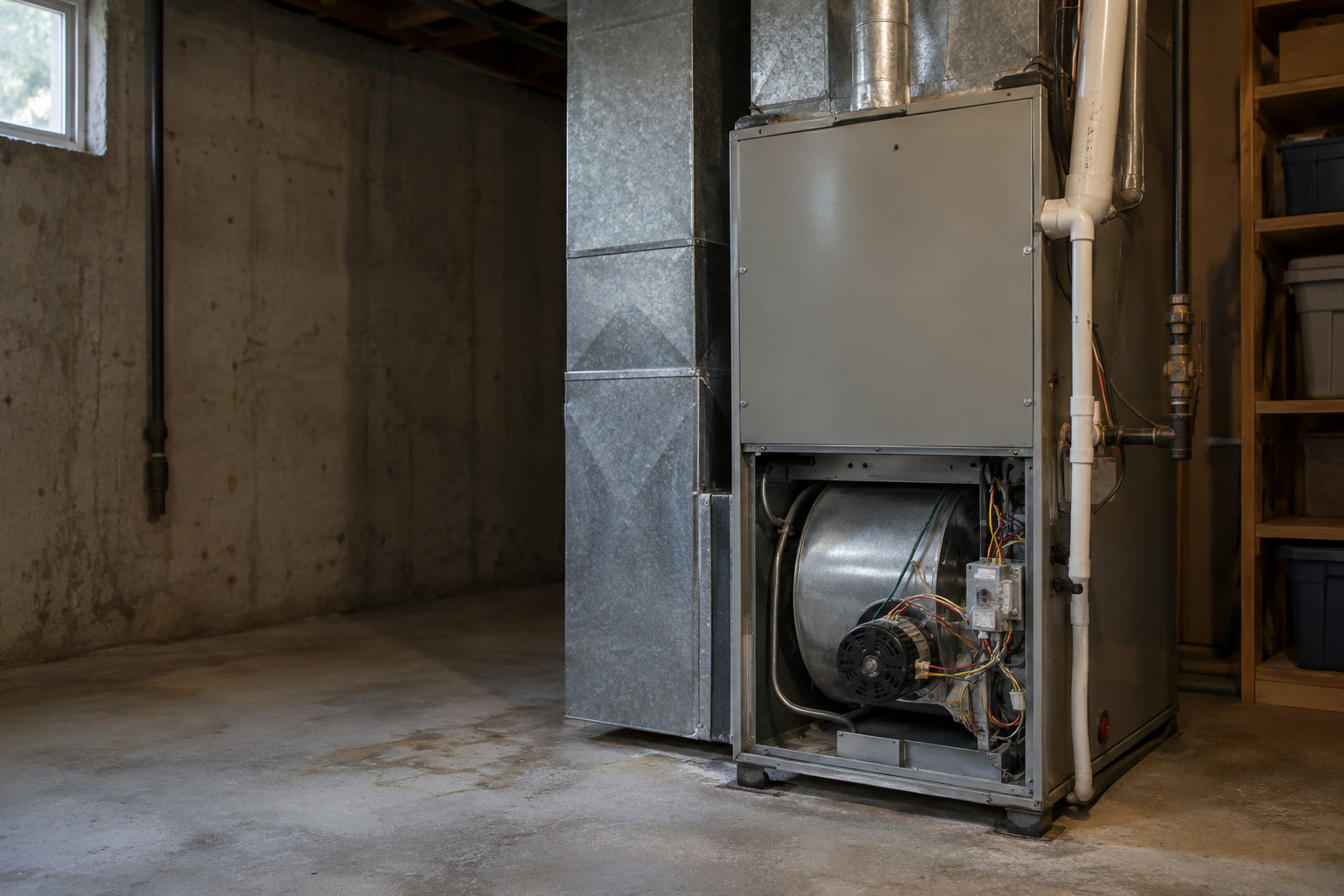
You do not need to know which part failed to call. You need to know what the furnace is doing: whether anything happens at all, whether the burners light and stay lit, whether air comes out, and whether there is a smell or a noise.
Find your symptom
Not heating
Cold air or no useful heat
Caldwell furnace not heating? Separate missing heat from room airflow, record safe observations and ask for the test behind a repair proposal.
What the pattern meansWon't turn on
Silent equipment and heat commands
What to check firstKeeps shutting off
Heat starts, then stops early
Ignition or airflow?Igniter and flame sensor
Lighting and flame-proving faults
How each one failsBlower not working
Absent register air and fan controls
Motor, capacitor or relayNoisy furnace
A new scrape, rattle or bang
Match the noiseBurning smell
Odors, smoke and furnace safety
Safety before diagnosisWeak airflow
Uneven rooms and filter suitability
Filter, blower or ductsElectric furnaces
Elements and staged electric heating
Elements and sequencersHigh-efficiency furnaces
Drainage and high-efficiency vents
Drain, vents, switches
Gas, electric or high-efficiency?
Have the equipment model ready if you can read it without opening a service panel. Gas furnaces can use a metal flue or plastic vent pipes; condensing models have venting and drain faults of their own. An electric furnace has heating elements and a blower. A visible pipe or cabinet does not identify every system, so describe what you see and let the heating company confirm the equipment.
What is in scope, and what is not
What we service
- Gas furnace repair: igniters, flame sensors, pressure switches and gas valves
- Electric furnace repair: elements, sequencers and limit switches
- High-efficiency furnace repair: condensate drains, vents and pressure switches
- Blower motors, control boards and thermostats
- Furnace replacement where a repair is not worth it
What we do not service
- Boilers, radiant floor heat and geothermal systems
- Fireplaces, wood stoves and pellet stoves
- Air conditioners and evaporative coolers
- Commercial, industrial and agricultural equipment
- Duct replacement and whole-house duct redesign
Boilers, radiant floor heat and wood or pellet stoves are outside our residential furnace scope. For a problem with one of those systems, ask a specialist in the installed equipment.
Let’s get to the source of the heating problem.
Tell us where you are and what happens when you request heat. Gas, electric and condensing residential furnaces.
Have your ZIP code and furnace symptom ready.